
I still remember the first time I stayed up past midnight to watch a supermoon rise over the treeline behind my house. It wasn’t some grand scientific mission, I just couldn’t sleep, and there it was: enormous, copper-orange, and completely mesmerizing. That single moment turned me into a devoted moon-watcher for life.
If you’ve ever looked up at a glowing full moon and wondered what is it called this month? or when is the next one?, this guide is for you. I’m going to walk you through everything: the science, the traditional names, the dates, and exactly what to look for. No telescope required.
🌕 What Exactly Is a Full Moon?
Let’s start simple. A full moon happens when Earth sits almost perfectly between the Sun and the Moon. The entire sunlit face of the Moon turns toward us, and the result is that glorious bright disc we all recognize.
As NASA explains, the phenomenon of a full moon arises when our planet, Earth, is precisely sandwiched between the Sun and the Moon, this alignment ensures the entire side of the Moon that faces us gleams under sunlight.
Here’s something most people don’t realize: a full moon occurs in the middle of the lunar month when the Earth is directly between the Sun and the Moon, the Moon appears completely illuminated, giving the phase its name.
And here’s the rhythm behind it all: each lunar cycle is 29.5 days long, a constant and handy time unit that’s easier to use than individual days for tracking seasonal events. That’s why a synodic month is about 29.53 days on average, resulting in 12 or 13 full moons per calendar year, depending on how the lunar schedule aligns.
📅 2026 Full Moon Calendar: Every Date You Need
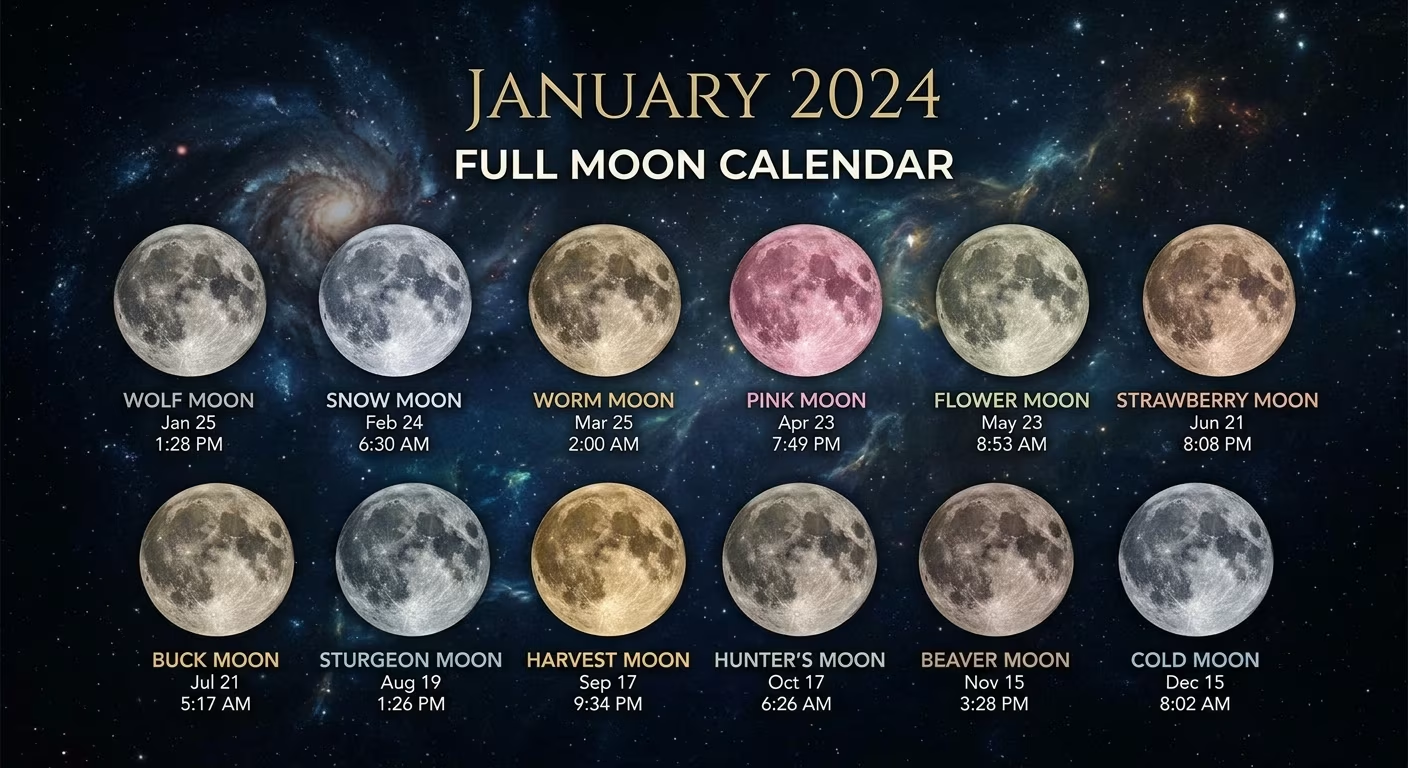
Below is your complete at-a-glance reference for all the full moons in 2026. I’ve included the traditional name for each, more on those in the next section!
| Month | Date (ET) | Traditional Name | Notes |
|---|---|---|---|
| January | Jan 3 | 🐺 Wolf Moon | Supermoon |
| February | Feb 1 | ❄️ Snow Moon | |
| March | Mar 3 | 🪱 Worm Moon | Total Lunar Eclipse |
| April | Apr 1 | 🌸 Pink Moon | Paschal Moon |
| May | May 1 | 🌷 Flower Moon | |
| May (Blue) | May 31 | 💙 Blue Moon | 2nd full moon in May |
| June | Jun 29 | 🍓 Strawberry Moon | |
| July | Jul 29 | 🦌 Buck Moon | |
| August | Aug 28 | 🐟 Sturgeon Moon | |
| September | Sep 26 | 🌽 Corn/Harvest Moon | |
| October | Oct 26 | 🏹 Hunter’s Moon | |
| November | Nov 24 | 🦫 Beaver Moon | Supermoon |
| December | Dec 24 | 🥶 Cold Moon | Supermoon (closest of year) |
Note: All dates are in US Eastern Time. Your local date may shift by one day depending on your time zone.
A few things stand out about 2026: there will be a second full moon in May, known as a ‘monthly blue Moon’, which means there are a total of 13 full Moons in 2026. Also, the Full Worm Moon occurs on March 3 and also brings a total lunar eclipse visible across much of the U.S.
🌾 The Fascinating Story Behind Full Moon Names
Every time I tell someone the full moon in January is called the “Wolf Moon,” they look at me like I’ve said something magical. And honestly? It is magical, and it’s ancient.
Across time, full moons were used to track the seasons, it was a method of timekeeping, and the full moons were often given special names that reflected nature’s signs.
Various Native American tribes each had their own full moon names, with traditions behind them rooted deeply in seasonal life. As the Native Partnership explains, each tribe named the full or new moons, or lunar months, in a unique way, some tribes used 12 names for the year, while others used as few as 5 or 6, and a moon name used by one tribe might represent a different season altogether.
Colonial Americans adopted some of the Native American moon names and applied them to their own calendar system; since the Gregorian calendar is the system that many in North America use today, that is how the list of moon names has been most widely presented.
Here’s a quick breakdown of each moon’s name and its meaning:
🐺 January, Wolf Moon
In the dead of winter, wolf packs were heard howling near villages. In January, it’s easy to picture packs of wolves howling at the Moon outside the villages in Europe and North America, as the winter’s rigors deprived the animals of food. The Full Wolf Moon occurs on Saturday, January 3, 2026, reaching peak illumination at 5:03 A.M. ET, and it’s also the year’s first supermoon.
❄️ February, Snow Moon
Typically a time of heavy snowfall in North America, February is when winter gives one final flourish, with the ground blanketed in white, it’s easy to understand why the full moon name known by many tribes is the Snow Moon.
🪱 March, Worm Moon
This moon is traditionally believed to be named after earthworms that come out of the warming spring soil. It’s a sign of thaw, of transition, and in 2026, it comes with the added spectacle of a total lunar eclipse.
🌸 April, Pink Moon
This full moon got its name from the blooming of “moss pink,” or wild ground phlox, one of the earliest spring flowers to appear. This Paschal Moon marks the first full moon of spring, playing a role in determining the date of Easter.
🌷 May, Flower Moon
This month, flowers bloom in abundance, giving May’s moon its bright, cheerful name. In 2026, May is special because it hosts two full moons.
💙 Blue Moon (May 31, 2026)
A Blue Moon is simply the second full moon within one calendar month. About every 2 to 3 years there are 13 full moons in a single calendar year, when this happens, the second full moon in a calendar month is called a Blue Moon, because the moon’s cycle of about 29.5 days doesn’t line up perfectly with our 365-day calendar.
Fun fact: The modern custom of calling the second full moon in a calendar month a Blue Moon started as late as the 1980s, and derived from an editorial error in the pages of Sky & Telescope.
🍓 June, Strawberry Moon
One of my personal favorites to say out loud. This was the time to gather ripening strawberries in what is now the Northeastern United States. According to NASA, this name comes from the Native American Algonquin tribes. The Full Strawberry Moon occurs on June 29 at 7:56 P.M. ET, ushering in summer, traditionally associated with the ripening of berries, it signals the start of strawberry season.
🦌 July, Buck Moon
A buck’s (male deer’s) antlers are in full growth mode this time of year. The Full Buck Moon occurs on Wednesday, July 29, 2026, at 10:35 A.M. ET, because it peaks during daylight hours, look for it rising after sunset in the southeast.
🐟 August, Sturgeon Moon
The Sturgeon Moon of August refers to a species of fish that can be found along the Atlantic Coast, stretching from the Gulf of Mexico to Newfoundland, sturgeon also inhabit the Great Lakes region. Sturgeon in the Great Lakes and Lake Champlain were said to be most readily caught during this full moon.
🌽 September, Harvest Moon / Corn Moon
Technically, the Harvest Moon is the full moon closest to the September equinox around September 22, it is the only full moon name determined by the equinox rather than a month, and most years it’s in September, but around every three years it falls in October.
🏹 October, Hunter’s Moon
Traditionally, people in the Northern Hemisphere spent October preparing for the coming winter by hunting, slaughtering, and preserving meats, giving it its Anglo-Saxon name Hunter’s Moon.
🦫 November, Beaver Moon
The full moon in November is named after beavers who can be seen preparing for the winter, Native Americans also called it the Frost Moon and Freezing Moon.
🥶 December, Cold Moon
December’s moon is fittingly named for the cold that grips the Northern Hemisphere. In 2026, it’s also the closest supermoon of the entire year, a perfect end to the lunar calendar.
🌟 What Is a Supermoon? (And Should You Actually Care?)
As someone who has photographed dozens of supermoons, let me give you the honest truth: they’re genuinely beautiful, but the hype is often a little exaggerated. Here’s what the science actually says.
A “supermoon” occurs when a full Moon coincides with the Moon’s closest approach to Earth in its elliptical orbit, a point known as perigee, during every 27-day orbit around Earth, the Moon reaches both its perigee, about 226,000 miles from Earth, and its farthest point, or apogee, about 251,000 miles from Earth.
At its closest point, the full Moon can appear up to 14 percent bigger and 30 percent brighter than the faintest Moon of the year, which occurs when it’s farthest from Earth in its orbit.
But here’s the catch: while a supermoon will indeed appear somewhat bigger and brighter in the sky, it would be difficult to tell the difference between an average full moon and a supermoon with the naked eye.
My advice? Go outside and enjoy it for what it is: the most dramatic version of the most familiar object in our night sky. Catch it near the horizon just after moonrise, that’s when the Moon illusion makes it look absolutely enormous, and that’s a trick your brain is playing on you in the best possible way.
According to eclipse expert and retired NASA astrophysicist Fred Espenak, there will be three full supermoons in 2026: in January, November, and December. Mark those dates, December 24 will be the closest supermoon of the year.
💡 Pro Tip: The best time to see any full moon, supermoon or not, is just after moonrise, when the Moon is near the horizon. It looks larger due to the Moon illusion, and the warm colors created by the atmosphere are stunning. Check your local moonrise time at timeanddate.com/moon.
🔭 How to Watch a Full Moon (No Equipment Needed!)
One of the things I love most about moon-watching is that it’s the most accessible hobby in astronomy. You don’t need a telescope. You don’t need an app. You just need to know when and where to look.
Here are my top tips from years of experience:
- ✅ Go outside 10, 15 minutes before moonrise, find your local time on timeanddate.com or The Old Farmer’s Almanac
- ✅ Find a low, clear horizon, east is where the Moon rises. A field, beach, or hilltop gives the best view
- ✅ Let your eyes adjust, give yourself 10 minutes away from bright screens before going out
- ✅ Bring binoculars if you have them, you’ll see craters and mountains on the lunar surface
- ✅ For photos, use a tripod, even smartphones take great moon shots when held steady
- ❌ Don’t miss the first 30 minutes after moonrise, that’s when the colors and illusion effects are most dramatic
For centuries, people have used the full moon to track seasons, guide planting, and mark religious and cultural events. You’re continuing a tradition that goes back to the very beginning of human civilization. That’s worth stepping outside for.
❓ Frequently Asked Questions
How many full moons are there in 2026?
There are 13 full moons in 2026. There will be a second one in May, known as a ‘monthly blue Moon’, which means there are a total of 13 full Moons in 2026.
What is the Harvest Moon?
The Harvest Moon is the full moon closest to the autumnal equinox, when sunset and moonrise meet. It’s special because, for several nights in a row, the Moon rises shortly after sunset, historically giving farmers extra light to bring in their crops.
Does a full moon really affect behavior?
This is one of the most common questions I get. Scientifically, there is no confirmed link between full moons and human behavior. Although the Sun and the Moon’s alignment cause a small increase in tectonic activity, many scientists have conducted studies and they haven’t found anything significant. What is real is that a bright full moon can disrupt sleep, the extra light at night is genuinely bright!
What is a micromoon?
The opposite of a supermoon. A Micromoon is when a full or new Moon is near its farthest point from Earth, around apogee. It is sometimes called a “Micromoon” by the news media, as it is slightly smaller (up to 14%) and dimmer (around 30%) than a Supermoon.
Why does the Moon look bigger near the horizon?
The supermoon may look especially large to you when it’s very close to the horizon, but that has nothing to do with astronomy and everything to do with how the human brain works. It’s called the Moon illusion, and it’s one of nature’s best optical tricks.
✨ Final Thoughts
After all these years of watching the Moon cycle through its names, Wolf, Snow, Worm, Pink, Flower, Strawberry, Buck, Sturgeon, Harvest, Hunter’s, Beaver, Cold, I’m still not tired of it. Each one feels like a chapter turning in a very old book.
Indigenous cultures have long held a deep reverence for all things natural as well as celestial, the movement of the Moon through its cycles was regarded as a guide to the passage of time, and more than mere timekeeping, this signpost was understood as a syncing of cosmic and earthly cycles.
Whether you’re a seasoned skywatcher or someone who just wants to step outside and appreciate the night sky a little more, bookmark this page, mark your calendar for the next full moon, and go look up. It’s free, it’s beautiful, and it connects you to every human being who has ever done the same thing across thousands of years of history.
Clear skies! 🌙
References
- “Supermoons”, NASA Science. NASA. Updated February 2026.
- “What’s a Supermoon and Just How Super Is It?”, NASA Jet Propulsion Laboratory. October 2024.
- “Full Moon Names for 2026”, The Old Farmer’s Almanac. Updated December 2025.
- “Native American Full Moon Names”, Sky & Telescope. Updated January 2026.
- “Moon Names”, Partnership With Native Americans (PWNA). Updated August 2025.
- “What Is a Supermoon and When Is the Next One?”, TimeandDate.com. Updated May 2026.
- “Full Moon Calendar 2026”, Royal Observatory Greenwich. Updated June 2026.