

Your Complete Guide to the Full Moon Calendar
For as long as humans have looked skyward, the full moon has served as a celestial clock — a glowing marker that punctuates the night sky with breathtaking regularity. Whether you are an avid stargazer, a curious newcomer to astronomy, or someone who simply enjoys stepping outside on a clear night to admire the lunar glow, understanding the full moon calendar opens up a whole new dimension of sky-watching. Each full moon has a precise date and time, a traditional name steeped in cultural history, and sometimes a special astronomical designation like a supermoon or a blue moon. This guide walks you through everything you need to know.
The Science Behind a Full Moon
A full moon is not simply “a really bright moon” — it is a specific, measurable moment in the lunar cycle. A full moon is visible when the whole Earth-facing side of the Moon is illuminated by sunlight, which happens as Earth orbits the Sun and the Moon in turn orbits Earth; when it is “full,” the Moon is on the opposite side of the Earth from the Sun. At that precise instant, the Sun, Earth, and Moon align so that the lunar surface facing us is fully bathed in sunlight.
As the Moon orbits the Earth, sunlight and shadow sweep across its surface in a 29.5-day cycle that waxes from new Moon to full Moon and back again. This rhythm — just under a month — is the basis for the word “month” itself, derived from the word “moon” in many languages. The eight lunar phases are: new moon, waxing crescent, first quarter, waxing gibbous, full moon, waning gibbous, third quarter, and waning crescent.
Understanding where the full moon sits in this progression helps skywatchers plan their viewing. The most noticed monthly variation in the Moon’s appearance is the cycle of phases, caused by the changing angle of the Sun as the Moon orbits the Earth; the cycle begins with the waxing crescent Moon visible in the west just after sunset, the Moon is high in the sky at sunset and sets around midnight at first quarter, and the full Moon rises at sunset and is high in the sky at midnight.
Why the Moon Has an Elliptical Orbit — and Why It Matters
Not all full moons look alike. The difference in the Moon’s apparent size from month to month comes down to orbital geometry. The Moon’s orbit around Earth isn’t a perfect circle — it’s elliptical, or egg-shaped, meaning that sometimes the Moon is closest to Earth in its orbit (perigee) and sometimes it’s furthest from Earth in its orbit (apogee).
The Moon approaches and recedes from Earth, appearing to grow and shrink, and the two extremes — called perigee (near) and apogee (far) — differ by as much as 14%. This is why some full moons look noticeably larger or smaller than others, giving rise to two popular terms: the supermoon and the micromoon.
Supermoons, Micromoons, and Other Special Full Moons
What Is a Supermoon?
A supermoon is a full moon that occurs when the Moon is at least 90 percent of the way to perigee — its closest approach to Earth — and it looks about 7 percent larger and 15 percent brighter than an average full moon. While the difference can be subtle from night to night, side-by-side photographs of supermoons and micromoons reveal a striking contrast. A supermoon can appear up to 14% larger and 30% brighter than a micromoon — a full moon at apogee, the farthest point in its orbit.
- Perigee full moon (Supermoon): Moon at closest orbital point — bigger and brighter appearance
- Apogee full moon (Micromoon): Moon at farthest orbital point — smaller and dimmer appearance
- Consecutive supermoons: The 2025 calendar closed with three supermoons in a row: the October Harvest Moon, the November Beaver Moon, and the December Cold Moon.
What Is a Blue Moon?
Despite the poetic name, a blue moon is almost never actually blue. By the modern definition, a blue moon is the second full moon in a calendar month; the original definition is the third full moon in a season that has four. The phrase “once in a blue moon” comes from this rarity. On average, a monthly blue moon happens every two to three years.
What Is a Blood Moon?
A Blood Moon occurs during a total lunar eclipse, when the Earth moves directly between the Sun and the Moon, casting a shadow that gives the Moon a reddish hue; every total lunar eclipse is a blood moon, though the degree of redness varies based on atmospheric conditions like dust, pollution, and volcanic activity, and some total lunar eclipses appear deep red while others may be more orange or copper-toned.
Traditional Full Moon Names — A Cultural Legacy
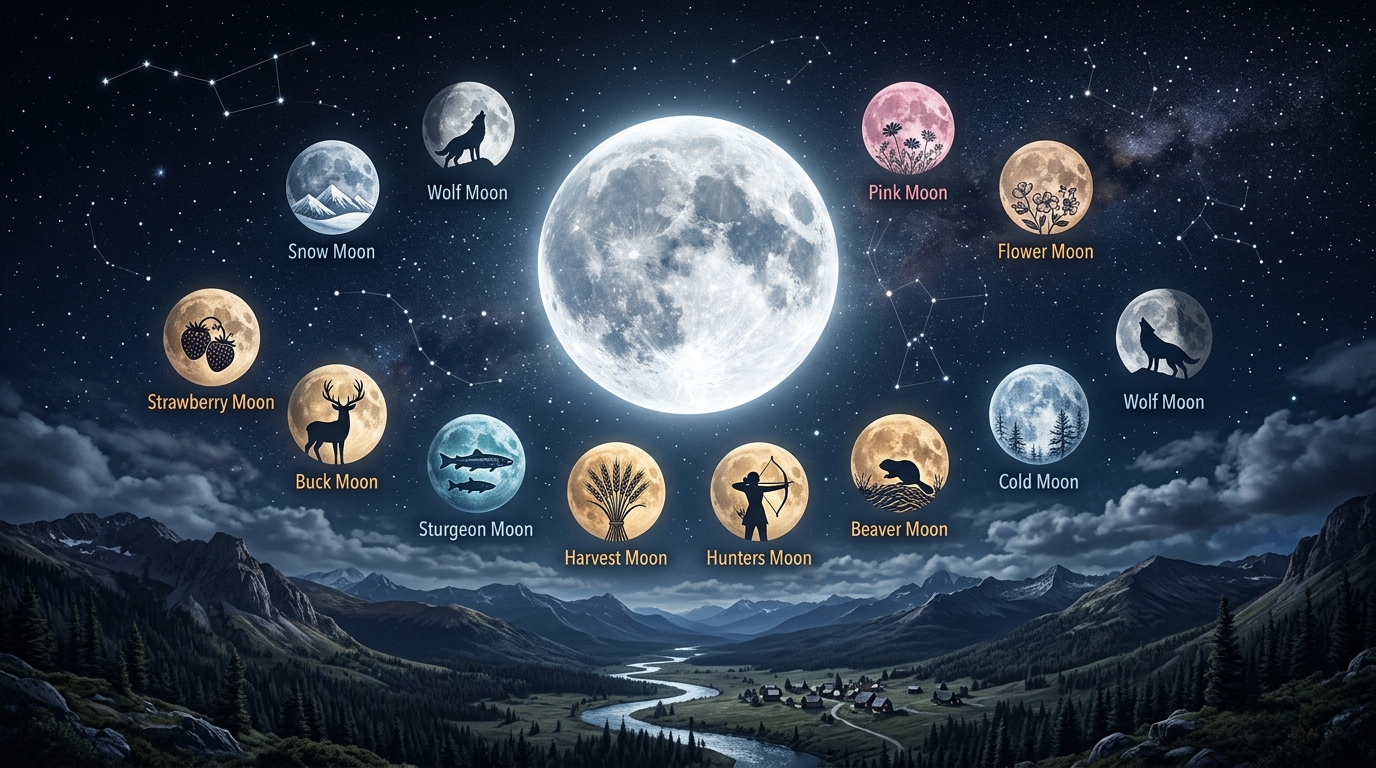
Every full moon carries a name, and those names are far more than poetic labels. They are ancient calendars in themselves, connecting modern skywatchers to centuries of agricultural tradition. The names trace back to Native American tribes — especially Algonquian-speaking peoples of the Northeast — who tagged each month’s full moon to the season’s natural events; wolves howling in January, worms surfacing as the ground thawed in March, sturgeon running in August, and European settlers adopted the custom while almanacs have published the names since the 1930s.
Before the widespread use of calendars, people used the lunar cycles to keep track of time and to plan their activities; naming the full moons helped to identify and remember specific times of the year, and many full moon names are associated with seasonal events and agricultural practices.
Monthly Full Moon Names at a Glance
| Month | Traditional Name | Origin / Meaning |
|---|---|---|
| January | Wolf Moon | Named after the wolves howling in the cold winter nights of January. |
| February | Snow Moon | February typically brings the heaviest snowfall of the year in North America. |
| March | Worm Moon | Named for the earthworms that surface as the ground begins to thaw in early spring. |
| April | Pink Moon | The name represents the hue of the wild ground phlox — one of the earliest flowers to bloom in April. |
| May | Flower Moon | Named to honor the abundance of wildflowers blooming across spring landscapes. |
| June | Strawberry Moon | Marks the brief strawberry harvesting season observed by many Native American tribes. |
| July | Buck Moon | Named for male deer (bucks) whose antlers are in full growth mode during midsummer. |
| August | Sturgeon Moon | Honors the large sturgeon fish most easily caught in Great Lakes and other water bodies at this time. |
| September | Harvest Moon | The full moon closest to the autumn equinox, historically used by farmers to extend harvest hours. |
| October | Hunter’s Moon | Named for the season when hunters tracked and stored game for winter. |
| November | Beaver Moon | Marks the time when beavers built their winter dams and trappers set beaver traps. |
| December | Cold Moon | Named for the long, frigid nights that characterize the depths of winter. |
These moon names have no bearing on what the moon will actually look like, and don’t mean the moon on that date will look strange or unusual. They are purely cultural and seasonal identifiers.
The Easter Connection: When the Moon Sets the Calendar
The cultural influence of the full moon extends even into the religious calendar. The April Pink Moon is the first full moon after the spring equinox, making it also the Paschal Moon, and in the Christian ecclesiastical calendar, the first Sunday after the Paschal Moon is the date of Easter. This ancient lunar-solar calculation, dating back to the Council of Nicaea in 325 CE, is a powerful reminder of how deeply lunar cycles have shaped human timekeeping and religious tradition.
How to Observe the Full Moon — Practical Tips for Skywatchers
You do not need an expensive telescope or special equipment to enjoy a full moon. You don’t need special tools to see the difference between a supermoon and a regular moon — simply go outside and watch the moon rise or set, and it looks especially large when it is near the horizon because of an optical trick called the “moon illusion.” For the most dramatic view, head to an open area away from city light pollution.
- Best viewing time: The full moon rises at sunset and is high in the sky at midnight.
- Moon illusion: The moon appears largest near the horizon — this is a well-documented perceptual effect, not a physical change in its size.
- Photography tip: Use a telephoto lens, a tripod, and shoot during the “blue hour” just after sunset for the most dramatic contrast between the moon and the sky.
- Dark skies: Driving 20–30 miles outside a major city can dramatically improve your view of the full moon and any nearby stars or planets.
- Apps and tools: Several free astronomy apps allow you to track moonrise and moonset times specific to your geographic location.
The Full Moon and Its Effect on Tides
Beyond spectacle, the full moon has a measurable physical effect on Earth. The Moon’s gravitational pull plays a huge role in the formation of Earth’s ocean tides. When the moon is new or full, the tides are maximum because the attraction forces of the Sun and the Moon add up. These are called spring tides — not because of the season, but because the water “springs” higher. Coastal communities, ship navigators, and fishermen have relied on this predictable lunar influence for millennia.
Full Moons Across World Cultures
The Moon has always had a strong connection with people around the world; many festivals and traditions still follow its phases, and events like the Mid-Autumn Festival, Easter, and Hindu Purnima days are all linked to the lunar calendar. In Buddhist traditions, Vesak — the celebration of the Buddha’s birth, enlightenment, and death — falls on the full moon of May. In Islam, the lunar calendar governs the timing of Ramadan and Eid. Across virtually every major civilization, the glowing full moon has served as a shared celestial reference point.
The full moon means many things to many people and has been a time of significance and symbolism for thousands of years. From Mesopotamian astronomers to modern amateur stargazers, ancient Mesopotamian farmers, Celtic druids, Roman philosophers, Aztec priests, and people today all see the same moon.
Frequently Asked Questions (FAQs)
How often does a full moon occur?
Astronomically, the full moon rises in the sky roughly every 29.5 days; at that time, the Sun fully illuminates the Moon, making it shine brightly in the night sky. This means most calendar years contain 12 full moons, though some years have 13.
How many full moons are there in a year?
In 2025, we’ll see 12 full moons; three of them are supermoons, which means they look bigger and brighter than usual. In years where 13 full moons occur, the “extra” one is known as a blue moon.
What is a supermoon exactly?
Supermoons occur when the moon is at its closest point to Earth in its orbit, and they appear larger and brighter than regular full moons; in astronomical terms, this time when the moon is closest is called the perigee, and it also affects the tides.
Can the full moon affect human behavior or sleep?
This is a popular topic in folklore and popular culture. Scientific research on the subject has produced mixed findings, and no robust consensus currently exists linking the full moon to significant behavioral changes in humans. That said, the extra light from a full moon can affect sleep quality for some individuals who are sensitive to nighttime brightness.
How long does a full moon last?
Technically, the full moon is a single moment in time — the precise instant when the Moon reaches maximum illumination as seen from Earth. However, to the naked eye, the moon appears full for about two to three nights centered on that peak moment. To the unaided eye, the Moon will appear fully illuminated the day before and after the exact date.
Why are full moon names different across different sources?
Because full moon names originate from diverse indigenous nations and cultural traditions, there is no single authoritative list. Different tribes and regions assigned different names to the same moon. Most Western almanacs draw primarily from Algonquian-speaking nations of northeastern North America, but other traditions — Celtic, Anglo-Saxon, and others — also contribute names that sometimes appear in popular publications.
What is the Harvest Moon?
The Harvest Moon is the full moon that occurs nearest the autumnal equinox (around September 22–23). Because it rises close to sunset on consecutive nights near the equinox, it historically gave farmers extra hours of natural light to bring in their crops before the onset of winter — a practical gift from the night sky.
Summary: Making the Most of the Full Moon Calendar
Tracking the full moon is one of the most accessible and rewarding forms of astronomical observation available to anyone with a clear sky and a few minutes to spare. Each month’s full moon arrives on a predictable schedule, carries a name that links us to centuries of human tradition, and sometimes arrives with special characteristics — shining brighter as a supermoon, appearing smaller as a micromoon, or glowing blood-red during a total lunar eclipse. Whether your interest is scientific, cultural, spiritual, or purely visual, the full moon calendar gives you a reliable rhythm to follow throughout the year.
Mark the upcoming dates, step outside on the night of the full moon, and look up. The same light that guided ancient farmers, inspired mythologies, and governed religious calendars is still there — brilliant, punctual, and endlessly fascinating.
References
- Moon Phases — NASA Science — NASA Science. 2023-06-06. https://science.nasa.gov/moon/moon-phases/
- Moon Phase and Libration, 2025 — NASA Scientific Visualization Studio — NASA SVS / Fred Espenak. 2025-09-23. https://svs.gsfc.nasa.gov/5415
- Moon Phase and Libration, 2026 — NASA Scientific Visualization Studio — NASA SVS. 2026-02-18. https://svs.gsfc.nasa.gov/5587
- Full Moon Calendar 2025: Full Moons With Names, Dates, Supermoons, And Eclipses — StarWalk Space. 2025-11-11. https://starwalk.space/en/news/full-moon-calendar-2025
- When Is the Next Full Moon? 2026 Dates, Times & Calendar — Farmers’ Almanac. 2026-06-17. https://www.farmersalmanac.com/full-moon-dates-and-times
- Full Moons of 2025: Names, Dates, and Everything You Need to Know — Live Science. 2025-12-05. https://www.livescience.com/space/the-moon/full-moons-of-2025-names-dates-and-everything-you-need-to-know

Comments are closed, but trackbacks and pingbacks are open.